Fuzhounese Communities in the USA

The Fuzhounese diaspora has profoundly shaped the demographic and economic landscape of the American East Coast. From establishing the sprawling intercity bus networks to operating tens of thousands of takeout restaurants, the community has built vibrant "Little Fuzhou" enclaves where the Min Dong dialect remains the language of daily commerce and life.

The Big Three: New York City's Chinatowns

Sunset Park, Brooklyn

Centered heavily around 8th Avenue in Brooklyn, Sunset Park is the undisputed current epicenter of Fuzhounese culture in America. Often referred to as the newest and largest "Little Fuzhou," it boasts the highest concentration of Fuzhounese residents in the country.

Walking down 8th Avenue, the primary language you will hear from street vendors, bakers, and seafood market owners is the Fuzhou dialect. The neighborhood experienced explosive growth in the 2000s and 2010s as families sought more space than Manhattan could offer, transforming a quiet residential area into a bustling, 24/7 commercial powerhouse packed with specialized regional restaurants and wedding banquet halls.

Sunset Park Brooklyn 8th Avenue Fuzhou Community
East Broadway Manhattan Little Fuzhou

East Broadway, Manhattan

While the traditional western portion of Manhattan's Chinatown (Mott and Canal Streets) is deeply rooted in Cantonese and Toisanese history, the eastern edge stretching along East Broadway under the Manhattan Bridge became the original "Little Fuzhou" during the massive immigration waves of the 1980s and 90s.

This corridor was the central nervous system for new arrivals. It housed employment agencies that dispatched restaurant workers to all 50 states, boarding houses, and the iconic intercity buses (like the famous Fung Wah buses) that connected Fuzhounese workers to out-of-state jobs. Though many families have upwardly mobilized and moved to Brooklyn or the suburbs, East Broadway remains a deeply nostalgic and historical cornerstone for the community.

Flushing, Queens

Flushing is widely considered the most diverse of New York City's Chinatowns. While it is predominantly Mandarin-speaking, serving as a hub for immigrants from Northern China, Taiwan, and Wenzhou, a significant Fuzhounese community has established a strong foothold here as well.

Because Flushing functions as a massive commercial center, many Fuzhounese entrepreneurs operate businesses here. You can find authentic Fuzhounese fishball soups and peanut noodles thriving in the famous subterranean food courts of Flushing, existing harmoniously alongside Sichuan hotpot and Dongbei dumplings.

Flushing Queens Chinatown Skyline

Beyond New York: The East Coast Network

Philadelphia Chinatown Friendship Gate

Philadelphia Chinatown

Philadelphia's Chinatown experienced a massive revitalization and expansion in the late 1990s and 2000s, driven almost entirely by an influx of Fuzhounese immigrants seeking lower living costs and business opportunities outside of New York.

Today, Philadelphia stands as one of the most robust Fuzhounese strongholds on the East Coast. It is intricately tied to New York's East Broadway through a constant stream of daily commuter buses, allowing families, restaurant supplies, and cultural ties to flow freely between the two cities.

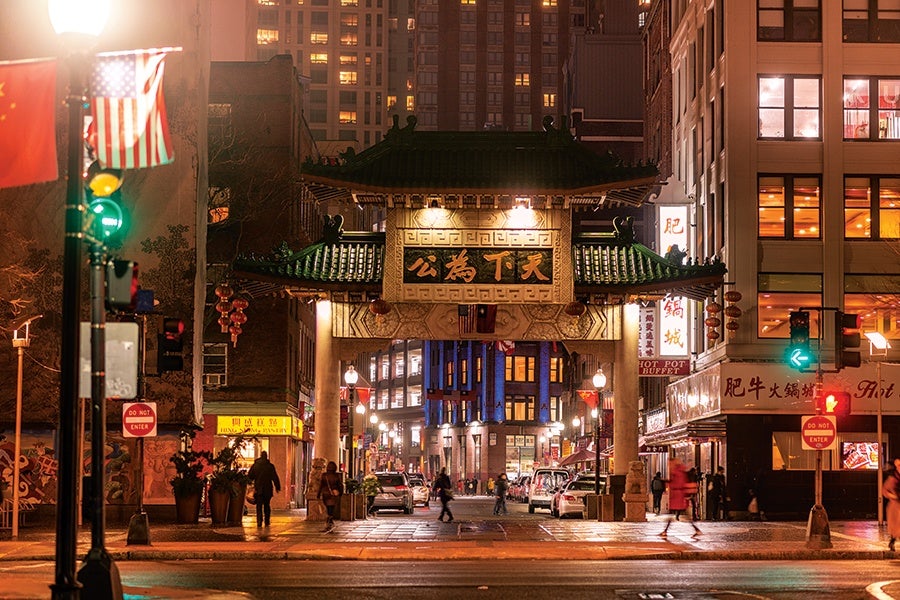
Boston Chinatown

Boston serves as the northern anchor for the Fuzhounese East Coast network. While Boston’s Chinatown was historically dominated by early Toisanese and Cantonese immigrants who established the initial infrastructure, demographic shifts over the last three decades have changed the landscape.

Fuzhounese residents now make up a substantial portion of the community, managing many of the local wholesale suppliers, markets, and restaurants. Like Philadelphia, Boston remains deeply connected to the New York hubs, ensuring the Min Dong dialect continues to be a vital part of the city's Asian-American fabric.

Boston Chinatown Gate